Shortcuts
  • Common Ground
  • Summer Conference
  • Residential Fellowship
  • Vocational Programme
  • Sign Up
  • Instagram
  • Facebook
  • Lead Programmes
    • Summer Conference
    • Residential Fellowship
    • Vocational Programme
    • Evening School
  • Vocational Centres
    • Centre for the Arts
    • Centre for Business & Leadership
  • Courses & Events
    • Conversation Evenings
    • Short Courses
  • Resources
    • Store
    • Common Ground Magazine
    • Venn Presents
  • Who We Are
    • About
    • Our Story
    • Our People
  • Donate
  • Contact
Venn Foundation
58 Hillsborough Road
Hillsborough, Auckland 1042
Email: mail@venn.org.nz Phone: +6499294988
PO Box 163138
Lynfield, Auckland 1443
Image from Flickr, CC Zero
  • Link copied!

How to Vote Responsibly

By Nathan McLellan >> 16 min read
Creation, Society, Culture Lead Articles

I.

Election season is upon us, and once again we’re faced with the issue of how to vote. It is a vexed issue for individual Christians and for the Christian community in Aotearoa, New Zealand. Many of us feel the tension and dissonance of voting when no single party clearly aligns with all our beliefs, values, and policy judgements. We are aware of the potential for discussion of this kind to foment suspicion, ill will, and fractures within the Christian community. Those of us who have read and thought about the Church’s political, social, and economic teaching, and the different ways this might take form in our institutions and policies, know how difficult it is to have genuine dialogue because of assumptions that people bring to the discussion (for instance, particular views on how social change takes place, or different theological takes on power and authority) and because of misunderstandings (such as confounding the separation of the institutions of church and state with Christian faith and politics). Yet these hurdles are worth mounting for the prize of knowing that we have set out to be responsible Christians and citizens who are pursuing the good of Aotearoa, New Zealand, as best we can.

This article seeks to address the question of how to vote by addressing two questions:

As a Christian, what’s my responsibility when it comes to voting?
How do I prepare to vote responsibly?

That word responsibility is doing significant work here. It’s a term we use a lot in our everyday speech without a moment’s reflection. “Are you responsible for this mistake, Nathan?” “He’s a responsible parent.” “It’s not my responsibility!” It’s an ethical term that relates to a person’s (or an institution’s) obligations or duties within a given context: “Yes, I am responsible for the grammatical mistake because it was my duty to edit the article.” “He’s a responsible parent because he fulfils the obligation to care for his children.” “It’s not my responsibility to correct a misdemeanour because I’m not authorised to do so.” (This last example is interesting because it recognises that there are limits to one’s obligations and duties). When it comes, then, to Christians voting responsibly and preparing to do so, we’re considering our obligations or duties as Christians within the political context that we find ourselves.

II.

Arising from the study of Scripture and the development of its political, social, and economic teaching, the Church calls her members to work for the common good of those political communities where her members find themselves. By political communities I mean: those communities in which humans are joined together such that their lives are intertwined and affect each other; in which there should be a mutual interest in seeking the common good—that is, the set of conditions and combination of goods that enable all members of the political community to flourish. In other words, Christians find themselves in political communities at various levels—neighbourhoods, cities, and nations—alongside others who don’t share their Christian beliefs and commitments, and where we nonetheless have a responsibility to seek the good of all, following Christ’s instruction to love our neighbours as ourselves (Matthew 22:39; Mark 12:31).

For Christians, as for many others, there is an objective aspect to the conditions and goods that constitute the common good, such as food and shelter, law and order, access to education and health care, personal freedoms, and so on. How we understand and recognise the common good as Christians is governed by our belief in the nature and character of the triune God who created and now sustains the world with certain ends in mind. That belief is also sensitive to: the fragility and difficulty of nurturing the common good; the reality that we lack complete understanding about the form the common good should take at any moment in history; and the fact that others pursue the common good for reasons that are different from ours because they don’t necessarily share the same beliefs. Therefore, in the pluralistic context within which we find ourselves in Aotearoa, New Zealand, it makes sense that we are willing to listen and critically learn from others, explicate our own viewpoints, and engage in discussion and debate.

In referring to the political community, it is probably evident that I have a more expansive understanding of politics than we are accustomed to using. Robin Lovin has written that “we tend to reserve the term ‘politics’ for the sphere of law and government.” In this understanding: “Politics is concerned with the control of states, and politics among nations is concerned with relations between states. Sometimes, the activities of the state and its agencies are designated as “public”, in contrast to the large and undifferentiated “private” sphere that includes religion, culture, commerce, and family life.” But here, following Lovin, I’m using the term political community in the broader—and original—sense, meaning the wider set of institutions and activities that comprise our life together, and the way these are organised and ordered so that all members of the political community might flourish. This wider conception of the political community includes families, schools and universities, businesses and workplaces, churches, community groups, and their activities. When Christians are called to seek the common good of Aotearoa, New Zealand, it is with this wider conception of the political community in firm view. We are to embrace our roles within and work for the betterment of our families, workplaces, churches, and so on, believing that if these institutions fulfil their purpose, then each member of the political community in Aotearoa, New Zealand is more likely to flourish.

When Christians are called to seek the common good of Aotearoa, New Zealand, it is with this wider conception of the political community in firm view. We are to embrace our roles within and work for the betterment of our families, workplaces, churches, and so on, believing that if these institutions fulfil their purpose, then each member of the political community in Aotearoa, New Zealand is more likely to flourish.

The call to vote responsibly finds its place within this wider context. The state is a vital part of the broader political community with a particular role to play, including setting and upholding the law, overseeing the administration of a nation’s institutions, developing policy, protecting the vulnerable, and so on. As Christians living in a modern constitutional democracy, through voting we have a say in who will govern the state, set its laws, and shape its institutions and policies. This has not always been the case: for much of history, many members of most political communities had no say in who would govern them. Thus, we have the privilege—and the burden—of having some influence in determining who will govern us.

Christians, then, have a responsibility in the way they vote—as best as they can judge—to seek the common good in Aotearoa, New Zealand. In exercising that responsibility within a modern constitutional democracy, Christians face certain tensions, limitations, and ambiguities. This is not unique to our situation. The people of God have oftentimes found themselves in political contexts facing tensions, limitations, and ambiguities—in other words, in contexts where it’s hard to be completely at home. Indeed, a crucial passage that has shaped the Church’s teaching in calling its members to seek the common good—Jeremiah 29—was originally addressed to those who had been forcibly taken from their homes. Despite their sense of alienation at being exiled from their homeland and out of sync with the surrounding culture, God addresses the exiles as follows:

This is what the LORD Almighty, the God of Israel, says to all those I carried into exile from Jerusalem to Babylon: “Build houses and settle down; plant gardens and eat what they produce. Marry and have sons and daughters; find wives for your sons and give your daughters in marriage, so that they too may have sons and daughters. Increase in number there; do not decrease. Also, seek the peace and prosperity of the city to which I have carried you into exile. Pray to the LORD for it, because if it prospers, you too will prosper.” (Jeremiah 29:4-7)

Like these exiles, we are called to build houses and settle down; to plant gardens and eat what they produce; to seek the peace and prosperity of the political community of Aotearoa, New Zealand.

One significant tension we confront arises from the fact that those who comprise the political community don’t always share the same beliefs, commitments, and values as ourselves. I say “don’t always” because oftentimes they do; there can be significant overlap between what people want for Aotearoa, New Zealand, and a consensus on how to achieve it. But not always, and sometimes radically so. What is true here for the political community writ large is reflected across and within the different political parties. When it comes to voting for a political party to govern, we all face the tension of choosing one that, in all likelihood, does not fully reflect our beliefs, commitments, and values. When a government, then, is finally formed after a General Election, even if the party one votes for is part of the government, to a greater or lesser degree one will be governed by those who do not fully share the same set of beliefs, commitments, and values.

My beliefs, commitments, and values are determined and shaped by my Christian faith. I hope fundamentally and significantly so. My Christian faith, therefore, should inform how I vote, sometimes in a decisive way that calls for courage. But I also want to acknowledge that other things shape—and continue to shape—my beliefs, commitments, values, and policy judgments, and the weighting I give to these when voting. For example, my experiences in life, not least having lived in two different countries, or my background as an economist, which informs my views on the relative success of some policies over others. Your experiences and skills and expertise will also do the same for you. These other factors comprise one of the reasons why even Christians will vote for different political parties.

We face two further limitations when it comes to voting. First, although we have some apprehension of the common good for Aotearoa, New Zealand and what is required to achieve it, our understanding is not comprehensive. One cannot possibly know all the challenges and opportunities facing persons and communities throughout this whenua. Nor can one completely comprehend what resources need to be orchestrated to meet these challenges and opportunities, especially if they require particular expertise. This does not mean we need fall into a morass of moral and practical agnosticism or scepticism when it comes to knowing and pursuing the common good. It does, however, mean that when we do so, it is with a good measure of humility.

Second, not only are there limitations to our understanding because we are finite creatures and because the issues facing our political community are often complex, but we also wrestle with sinful impulses. Our desires are disordered and inordinate, though hopefully less so because of the sanctifying work of the Holy Spirit. This means, unless one is a saint, sinful impulses continue to influence our decisions and actions. Particularly relevant here when thinking about voting is our tendency to have an undue concern for our own interests and the interests of those social groups to which we belong. For this reason, we should be attentive to the temptations we confront generally, to aid us in voting responsibly.

In sum: we have a responsibility to seek the common good—the peace and prosperity—of Aotearoa, New Zealand, and this includes voting with integrity in relation to our commitments, values, and beliefs, as best as we are able. In doing so, we discharge this responsibility aware that we face certain limits and tensions. In other words, voting with integrity does not require complete alignment with a party’s values and policies, if the party represents the best available option as we weigh the pursuit of the common good given particular tensions and limits. How then might we prepare to do so as we approach the General Election?

III.

I offer four pieces of counsel, none of which are astounding or groundbreaking, but all of which are easier to write or read about, than to do.

Pray

First, we should pray. We should heed the instruction given to the exiles to pray to God for our political community. And as part of that prayer we should ask God to give us wisdom as we decide how to vote. We should allow the disquiet or concern that we feel about the upcoming General Election to move us to prayer, believing that when we humbly come before the triune God, wisdom is generously supplied (James 1:5).

Relatedly, we should pray for our political leaders. 1 Timothy 2:1-2 instructs us in the context of public worship, but, by extension, also in personal prayer:

I urge you, then, that petitions, prayers, intercession and thanksgiving be made for everyone—for kings and all those in authority, that we may live peaceful and quiet lives in all godliness and holiness.

I often find myself getting frustrated with politicians on both sides of the House in various ways. Often, I give voice to these frustrations with family and close friends. There is nothing wrong with doing this; however, I have felt convicted and prompted at times by the Holy Spirit to be just as ready—if not more so—to pray for our political leaders as to voice my frustrations with them! Our political leaders face significant opportunities and challenges. One of the things that prayer does is open us to what they might need in their vocations and lives.

Become informed about policies

Alongside prayer, there’s the need to become informed. What are the major policies of the political parties? What are the values and principles that underpin these policies? How might these policies contribute to the common good in Aotearoa, New Zealand? What challenges, trade-offs, and opportunities are in view? Taking the time to become acquainted with the major policies of the various political parties in the lead up to the General Election is integral to voting responsibly. Perhaps it’s worth setting aside two-to-three hours over a weekend to do this work. Taking time to visit the websites of political parties and become familiar with their key objectives and policies is a good place to start.

Reflect on political culture

In addition to becoming familiar with the key objectives and policies of the different political parties, it’s also worth considering the ways in which political parties are cultivating and contributing to a political culture or “ethos” that will promote and serve the common good. In other countries we have witnessed the fragmentation, division, and polarisation of the political community, partly because of the ways that political debate and interpersonal relating have been done. To further the common good in Aotearoa, New Zealand we need to preserve and further promote a political culture that undertakes productive disagreement and debate with respect for others and care for the realities of the situation.

Share and discuss

Finally, it’s also worth taking time to discuss your thinking with a few others—including those who you know don’t share your political standpoint. Indeed, in a time when polarisation and incivility abound, it is a significant act to take time to listen to others’ viewpoints, and to share our own with humility.

IV.

After the General Election—hopefully, not too long after—we’ll find a government has been formed. To greater or lesser degrees, we’ll find ourselves confronting the tensions and ambiguities described previously.

What do we do next? Well, first, what we always need to do: trust in God and God’s work in the world. Even in the midst of these tensions and ambiguities, I believe that God providentially appoints those who govern (Romans 13:1), while never endorsing or condoning everything that governments do. Indeed, politicians, like everyone else, will be required to give an account of their lives, including how they governed. Therefore, as N. T. Wright puts it, we are called to follow in the footsteps of the people of God through history who have been called upon to “accept that the rulers of the world were both appointed to their tasks by the one creator God and accountable to that God for the way they carried them out”. We can take some comfort from this affirmation.

Finally, we need to recall that our responsibilities as members of the political community in Aotearoa, New Zealand continue. We may have discharged one responsibility in voting, but our wider conception of politics means we have an ongoing responsibility to seek the common good in and through our homes, schools, businesses, workplaces, churches, community organisations, and so on. Here, I want to finish by highlighting a further responsibility as Christians: to share the good news about Jesus Christ with our family, friends, and neighbours that the reign of God has broken into the world, bringing with it his justice, righteousness, and peace. This is good news not only for our individual lives, but also for our political community, and indeed the entire creation.

This encouragement may seem jarring in an article on politics; however, it is a vital part of what it means to pursue the common good. People coming to know Jesus Christ as their crucified, risen, and ascended Saviour—as the one who is also the Lord of all creation, including every earthly power and authority—is a furtherance of the common good in the ultimate sense: the opportunity to enter into the fullness of life with Jesus Christ in the power of the Holy Spirit, as we are released from the rule of sin and death and enter into the rule of God. When we share the good news of Jesus Christ with our family, friends, and neighbours, we offer an invitation into the fullness of life—for now, but also in the life to come. When people accept this invitation, they in turn take this life of Christ in the power of the Holy Spirit back into their homes, schools, businesses, workplaces, and communities for the sake of the common good and for the glory of the triune God.

Creation, Society, Culture Lead Articles
More from
Nathan McLellan +

Keep
Exploring

You may also
be interested in

Kerry and John_feature
Field Notes: John Kleinsman
28 min read

All articles from
this edition

CGSepFeature 2
Common Ground
August 2023 Edtn

Also
on offer

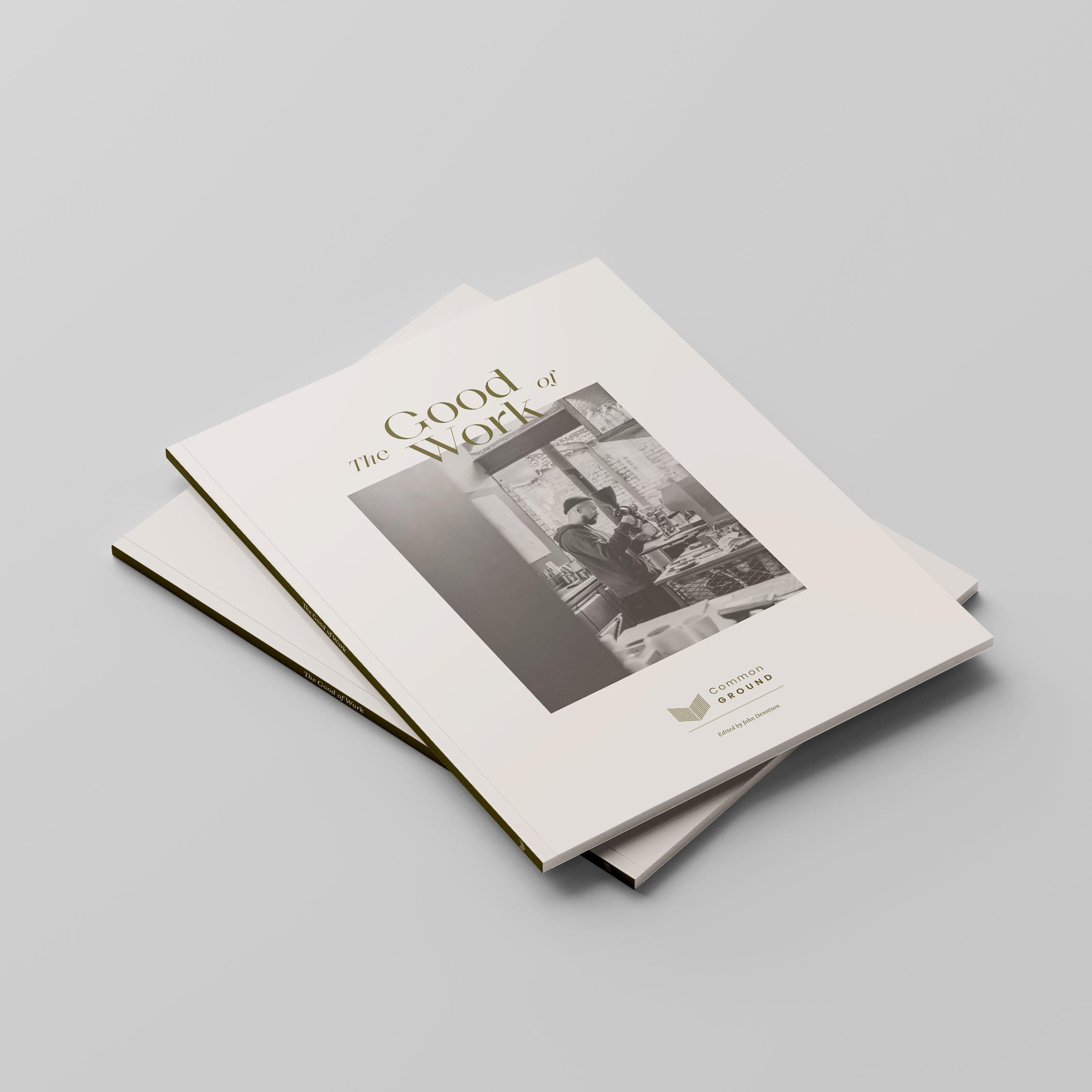
The Good of Work
Find out more

Common
Ground

December 2025 Edtn >>
Wait for the Lord

Sign up to receive Common Ground in your inbox

Sign Up
Shortcuts
  • Common Ground Editions
  • Residential Fellowship
  • Vocational Programme
  • Sign Up

Copyright © 2026
Venn Foundation

Venn Foundation

58 Hillsborough Road
Hillsborough, Auckland 1042

Email: mail@venn.org.nz

Phone: +64 (9) 929 4988

Post: PO Box 163138
Lynfield, Auckland 1443

Venn Foundation logo
Stay in the Loop

Receive all the latest information about Venn events, resources, programmes, and updates.

Sign Up
  • Instagram
  • Facebook
Support Us

Venn Foundation is a Charitable Trust (CC28328). If you would like to support our mission and work we would love to hear from you.

Donate Now

Design by Andy Campbell

Venn Foundation logo
  • Instagram
  • Facebook

Copyright © 2026
Venn Foundation

Design by Andy Campbell